Rodents & Wildlife
Termites & Timber
Stinging Pests
Crawling Insects
Property Programs
Not sure what you have?Describe what you have seen and we will identify it – no charge, no obligation.
All Services
Rodents & Wildlife
Termites & Timber
Stinging Pests
Crawling Insects
Property Programs
Company
Our WorkPricingProcessAboutContactCall 0435 073 966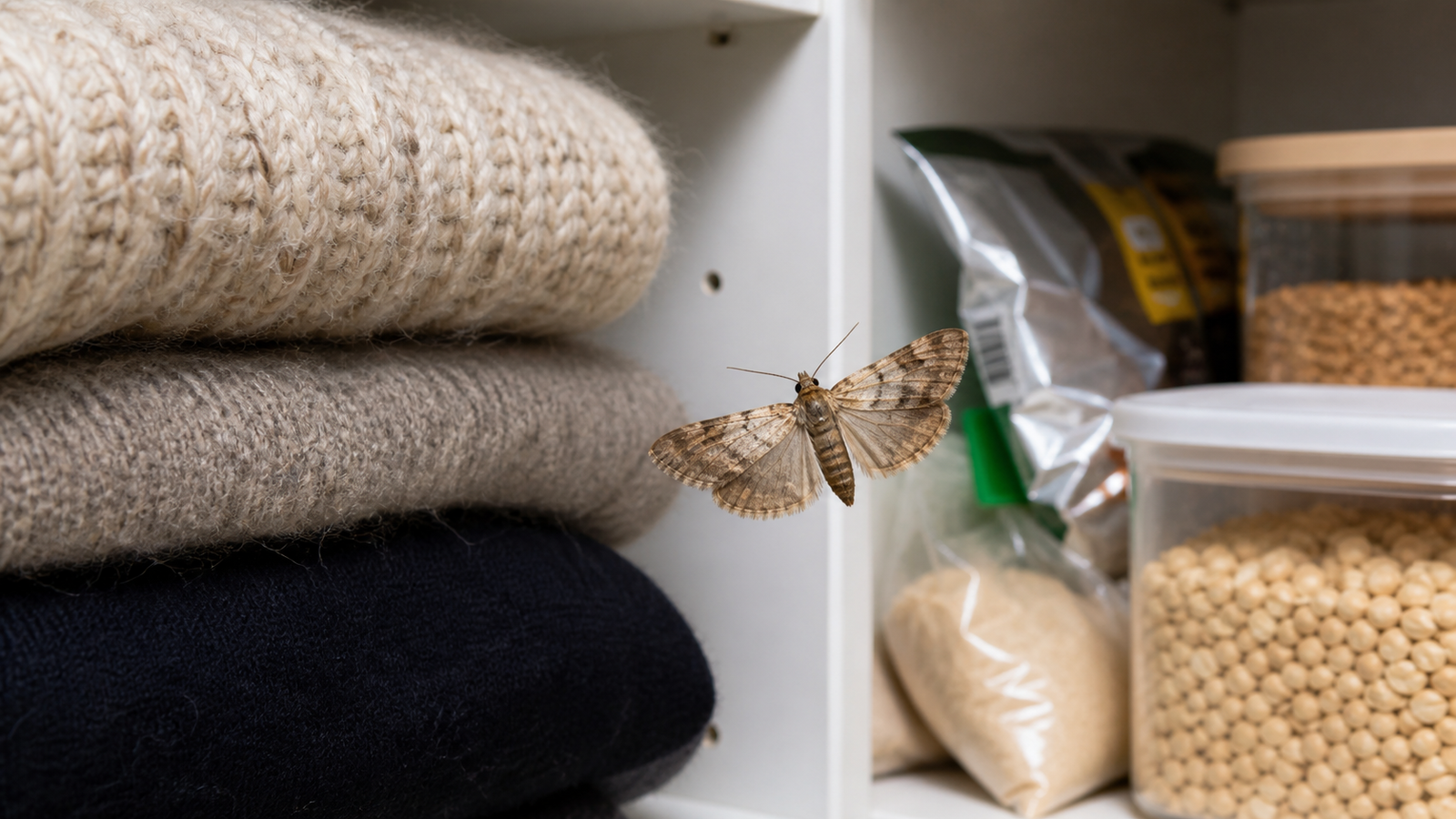
Home/Moth Control Melbourne
Wardrobes & pantries · Melbourne-wide · 24/7Moth Control Melbourne|Clothes And Pantry Moth Treatment
Holes in the wool, or moths in the pantry? We treat clothes and pantry moths across Melbourne, at the larvae. Call 0435 073 966 for a free quote.
Moths in the wardrobe or pantry? Start here
Tell us your postcode and whether the damage is in clothing or food. A technician calls you back with a clear written quote.
Request your quote
Takes under a minute – postcode and what you have seen is enough.
Your details go to our Melbourne office only.
The adult moths do not eat. The larvae do all the damage
This is the single most useful thing to know about moths, and it is almost never said plainly: an adult clothes moth has no functional feeding mouthparts. It cannot eat your jumper. Its entire job is to mate and lay eggs. Every hole in your wool was made by a larva, usually weeks earlier, somewhere dark and undisturbed.
So killing the moths fluttering around the room feels productive and achieves very little. The treatment has to reach where the larvae are living: the back of the wardrobe, under the wardrobe, carpet edges beneath furniture that never moves, and the folds of stored clothing.
The same applies in the pantry. Pheromone traps only attract males – they are a monitoring tool that tells you whether you still have a problem, not a treatment. Sold as a solution, they leave every female and every larva in place.
And the honest first step for pantry moths costs nothing: find the infested packet. There is almost always one source – flour, rice, nuts, pet food or birdseed – and until it goes in the outside bin, no treatment will hold.
Clothes Moth Or Pantry Moth?
Two completely different problems that only look similar from across the room.
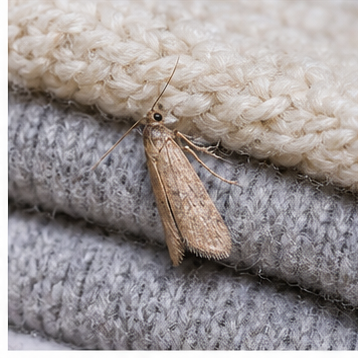
Clothes moth
Tineola bisselliella
Small, plain gold-buff, and a reluctant flier – it scuttles into dark corners rather than circling a light. The larvae eat animal fibres: wool, cashmere, silk, felt and fur, especially items stored unwashed.
How it is treated: Treatment of wardrobe interiors, under and behind furniture, and carpet edges where larvae live. Dry cleaning or hot washing affected items is part of it, and we tell you which.
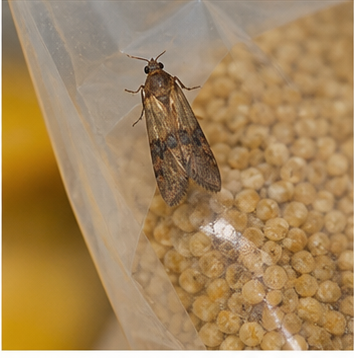
Pantry moth
Plodia interpunctella
Slightly larger, with a distinctive two-tone wing – pale near the head, coppery-bronze at the tips. Flies openly around the kitchen. Larvae leave silk webbing in dry goods and along shelf edges.
How it is treated: Find and bin the source packet, empty and treat the pantry, then monitor. Gel and residual treatment of shelving joints and hinges, and pheromone traps to confirm it is actually over.
What You Are Seeing
Six observations, and what each one tells us.
Small holes in wool, cashmere or silk
Clothes moth larvae. Look at items stored unwashed – body oils and food residue are what draw them to one jumper and not another.
Moths that scuttle into corners rather than fly at light
Clothes moths. Pantry moths fly openly around the kitchen; clothes moths avoid open space, which is why they go unnoticed for so long.
Silk webbing along a pantry shelf edge
Pantry moth larvae. Follow the webbing and it usually leads to the one packet everything came from.
Web and grains clumped in a flour or rice packet
The source. It goes in the outside bin, not the kitchen bin – larvae will simply crawl back out of a kitchen bin.
Tiny cream larvae on a wardrobe skirting
Clothes moth larvae looking for somewhere to pupate. It tells us the population is established, not incidental.
Damage in carpet under furniture that never moves
Classic clothes moth site – dark, undisturbed and often wool. This is the area that most DIY treatment misses entirely.
Four Steps, One Clear Quote
Treat where the larvae are, not where the adults are flying.
Identify and find the source
Clothes or pantry, and where the larvae actually are – the back of a wardrobe, under a bed, a carpet edge, or one packet in the pantry.
Clear written quote
Findings and price before we start, including which items need hot washing or dry cleaning and which packets simply need to go.
Treat the harbourage
Wardrobe interiors, under and behind furniture, carpet edges and skirtings for clothes moths; shelving joints, hinges and cupboard interiors for pantry moths.
Monitor and prevent
Pheromone traps as a monitor so you know when it is genuinely over, plus storage advice – sealed containers for dry goods, clean-before-storing for woollens.
Moth Control Cost Melbourne
Published, quoted in writing, and priced on the rooms involved.
Moth treatment
One or two rooms. Wardrobe or pantry, including harbourage treatment.
Whole-home clothes moth
Wardrobes, carpet edges and under-furniture areas throughout.
Pantry moth treatment
Pantry and kitchen cupboards, with monitoring traps included.
With general pest control
Added to a general treatment at the same visit.
What the price covers: identification, treatment of the harbourage where larvae live, monitoring traps, and written storage advice.
Comparing quotes? Melbourne moth control averages $150-400 and starts around $169, with pantry moth jobs $180-300. Check that the quote covers carpet edges and under-furniture areas for clothes moths – a wardrobe-only treatment misses where much of the damage happens. Send us any written quote and we will beat it by 5%.
Treated at the larvae, monitored afterwards
Moth work is easy to fake, because killing the adults you can see looks like progress. Ours targets the larvae and then gives you a way to check.
Three Things Most Moth Companies Will Not Tell You
Adult moths cannot eat your clothes
They have no functional feeding mouthparts. Every hole was made by a larva, weeks earlier, somewhere dark. Killing the adults you can see does not undo or prevent damage.
Pheromone traps are a monitor, not a treatment
They attract males only. Sold as a solution they leave every female and every larva in place – useful for telling you whether it is over, useless as the fix.
For pantry moths, the fix is usually free
Find the infested packet and put it in the outside bin. There is nearly always one source, and until it is gone no treatment will hold. We will tell you that before you book.
Often Booked With Moth Control
Same crew, same visit where it makes sense.
Moth Treatment Across Every Melbourne Suburb
One number covers the whole metro area, with no travel surcharge.
Moth Control Melbourne FAQs
The questions we are asked most, answered straight.
How much does moth control cost in Melbourne?
Ours starts from $169 for one or two rooms, $199 for a pantry moth treatment with monitoring traps, and $279 for a whole-home clothes moth job covering wardrobes, carpet edges and under-furniture areas. Melbourne rates average $150-400.
Do adult moths eat clothes?
No – and this is the most useful thing to understand about them. Adult clothes moths have no functional feeding mouthparts. The larvae do all the damage, usually weeks before you see an adult. Swatting the moths you can see does not protect anything.
Do pheromone traps get rid of moths?
No. They attract males only, so they are a monitoring tool that tells you whether a population is still active. Used alone they leave every female and every larva in place. We include them to verify the result, not as the treatment.
How do I get rid of pantry moths?
Find the source packet first – flour, rice, nuts, pet food or birdseed – and put it in the outside bin rather than the kitchen bin. Then empty and clean the pantry, and we treat the shelving joints, hinges and cupboard interiors where larvae pupate.
What is the difference between clothes moths and pantry moths?
Clothes moths are small, plain gold-buff and avoid open space, scuttling into dark corners; their larvae eat wool, cashmere, silk and fur. Pantry moths are slightly larger with a two-tone pale and coppery wing and fly openly around the kitchen; their larvae live in dry food.
Why is only one jumper damaged?
Larvae are drawn to fibres carrying body oils, sweat and food residue. An item stored unwashed is far more attractive than a clean one beside it, which is why damage often looks oddly selective.
Do I need to throw out my clothes?
Usually not. Hot washing or dry cleaning kills all life stages, and freezing for a week works for items that cannot take heat. We tell you which items need what before we start.
How do I stop them coming back?
Clean woollens before storing them, use sealed containers for dry goods, vacuum carpet edges and under furniture that never moves, and keep monitoring traps in the wardrobe. Those four things prevent nearly all repeat jobs.
Is the treatment safe around food and clothing?
Yes, applied as directed. Pantry work is done on emptied, cleaned cupboards and we tell you what needs wiping before food goes back. Wardrobe work targets the structure and carpet edges rather than the garments themselves.
Do you service my suburb?
Yes – all of metro Melbourne, from the CBD out through the northern, eastern, southern, bayside and western suburbs, with no travel surcharge.
Book moth control before 2pm today
Send your postcode and whether the damage is clothing or food. We will call back with a clear written quote.
Get my free quote
No obligation. Answered 24/7.
Your details go to our Melbourne office only.
Get your free quote
Quoted in writing before we start. Answered 24/7.