
Rodents & Wildlife
Termites & Timber
Stinging Pests
Crawling Insects
Property Programs
Not sure what you have?Describe what you have seen and we will identify it – no charge, no obligation.
All Services
Rodents & Wildlife
Termites & Timber
Stinging Pests
Crawling Insects
Property Programs
Company
Our WorkPricingProcessAboutContactCall 0435 073 966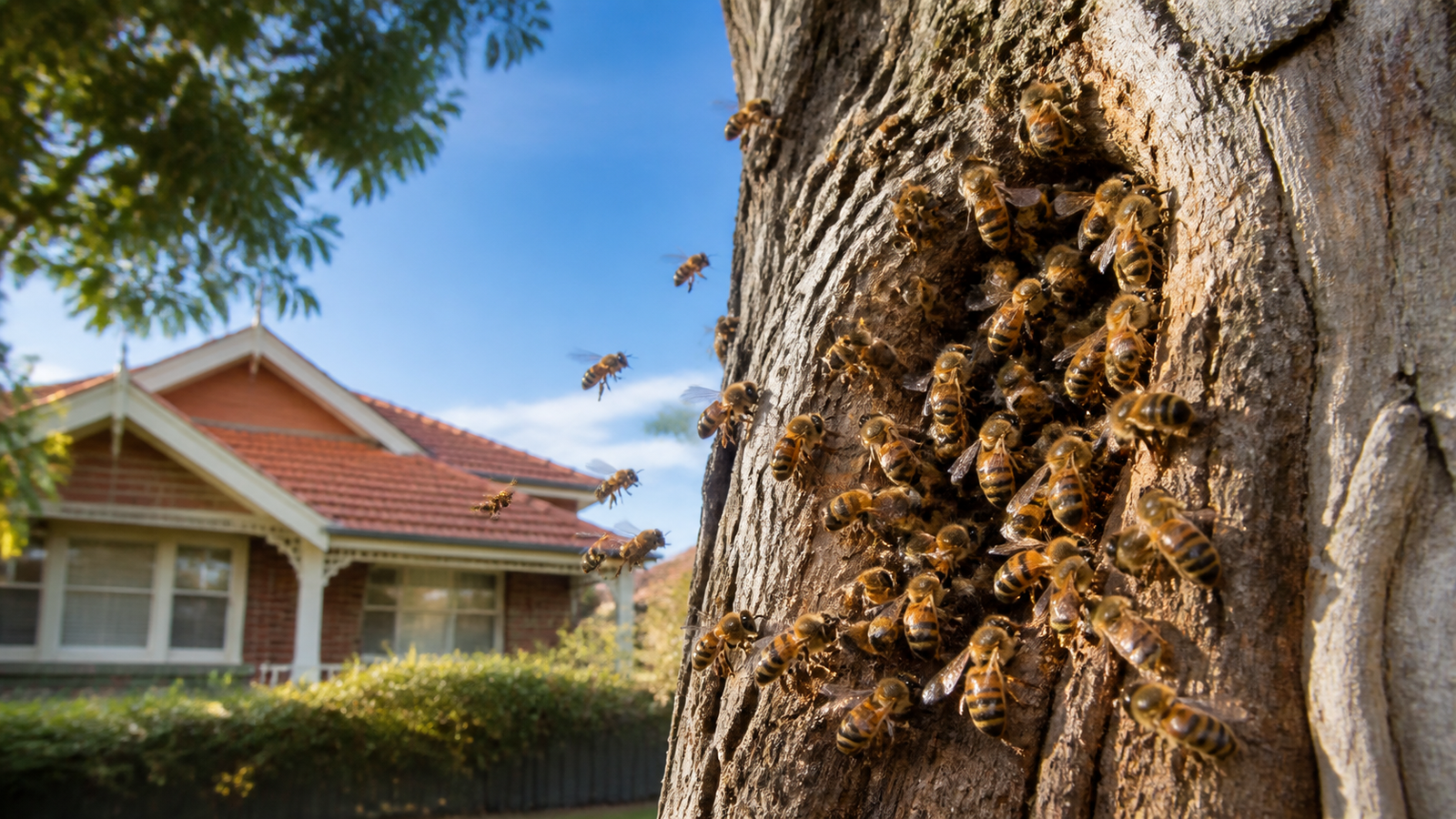
Home/Bee Removal Melbourne
Live relocation · Melbourne-wide · 24/7Bee Removal Melbourne|Live Bee Relocation, Never Sprayed
Swarm on a branch or bees in a wall? We remove bees across Melbourne and relocate every colony alive to a managed hive. Call 0435 073 966 for a free quote.
Bees on the property? Start here
Tell us your postcode and what you can see – a hanging cluster, or bees going into a wall. A technician calls you back with a clear written quote.
Request your quote
Takes under a minute – postcode and what you have seen is enough.
Your details go to our Melbourne office only.
Killing bees in a wall leaves you a worse problem than the bees
Spraying a colony inside a cavity is quick, cheap, and creates a mess that lasts for years. The wax comb is no longer cooled by the bees, so on the first hot Melbourne day it softens and collapses. Honey runs down inside the cavity, ferments, and comes through the plasterboard as a dark stain that will not paint out.
Then the second wave arrives. Unattended comb draws wax moth, small hive beetle, ants and rodents, all feeding on wax and dead brood. A pest problem you thought you had solved for $150 becomes a wall that has to be opened up and cleaned out anyway.
And the scent stays. Comb residue keeps advertising the cavity as a good home for years, which is why houses that were sprayed once tend to get swarms again and again in the same wall.
So our answer is the same every time: the colony comes out alive and goes to a managed hive, the comb and honey come out with it, and the cavity gets sealed so the next swarm cannot move in. Honey bees are also worth saving on their own merits – they are not the pest here, the cavity is.
Swarm Or Established Hive? Tell Them Apart In 30 Seconds
This single question decides the job and the price – and one of the answers is often ‘do nothing’.

A swarm
A hanging cluster, no comb
A football or rugby-ball shaped cluster of bees hanging on a branch, fence or gutter, arriving suddenly and usually gone within a day or two. There is no comb and no honey – they are house-hunting, not moving in.
What it means: The cheapest and easiest job, and often no job at all. Swarming bees are full of honey and unusually docile. If it is in a tree away from doorways, it may well leave on its own.

An established colony
Comb inside a cavity
Bees flying steadily in and out of one point in a wall, roof, chimney or floor, day after day for weeks. Behind that entrance there is wax comb, brood and honey.
What it means: A cut-out job. The cavity has to be opened, the comb and honey removed with the bees, and the space cleaned and sealed. More work, and the only approach that actually finishes it.

Bees on flowers in the garden
Foraging, not nesting
Bees working lavender, clover in the lawn or a flowering gum, then leaving. No cluster, no traffic into a single hole in the building.
What it means: Nothing to remove. This is a hive somewhere in the neighbourhood doing what bees do. We will tell you so rather than charge you for a visit.
Working Out What You Actually Have
Six observations, and what each one tells us before we arrive.
A dense cluster that appeared in a few hours
A swarm in transit. Usually docile, often gone within 24-48 hours, and the easiest possible removal while it is still hanging.
Steady two-way traffic at one hole, for weeks
An established colony inside the cavity. The longer it stays the more comb there is, and the bigger the cut-out job becomes.
A dark or damp stain spreading on an internal wall
Honey coming through the plaster. This usually means a colony that has been there a long time, or one that was sprayed and left.
A low humming you can hear through the wall
Colony noise inside the cavity – loudest on warm evenings. It tells us roughly where the nest sits behind the plaster.
Bees in one upstairs room, appearing at the window
They have found a way from the cavity into the living space. Close the door to that room and call – do not seal the outside entrance.
Fat, fuzzy bees carrying pollen on their legs
Honey bees, not wasps. Wasps are slim, shiny and carry nothing. It decides whether this is a relocation or a treatment.
Four Steps, One Clear Quote
Every colony comes out alive and goes to a managed hive.
Identify and locate
Swarm or established colony, bees or wasps. If there is comb in a cavity we work out where it sits before anything is opened, so we open the smallest area possible.
Clear written quote
Findings and price before we start. A swarm hanging in a tree is a very different number from a cut-out in a second-storey wall, and you get the honest one.
Remove the colony alive
Bees collected with the queen and rehomed to a managed hive. On a cut-out the comb and honey come out too, because leaving them is what causes the stains and the second infestation.
Clean and seal
The cavity is cleaned of residue and the entry point sealed, so the scent does not advertise the same wall to next season’s swarm. Twelve-month warranty on the seal.
Bee Removal Cost Melbourne
Published, quoted in writing, and priced on swarm versus cut-out.
Swarm collection
An accessible hanging cluster collected and rehomed to a managed hive.
Hive cut-out
Comb, honey and colony removed from a wall, roof or floor cavity, then cleaned and sealed.
Complex or structural
Height access, roof cavities or where significant opening up and making good is needed.
Bee proofing
Sealing the cavity and likely entry points after the colony is out.
What the price covers: locating the colony, removing it alive with the queen, rehoming to a managed hive, removing comb and honey on cut-out jobs, and sealing the entry point.
Comparing quotes? Melbourne swarm collection runs roughly $50-100 for an easy one, and structural removals $100 to $1,000-plus depending on access. Some beekeepers collect easy swarms free in exchange for the bees – if that is your situation we will say so. What matters on a cut-out is whether the comb and honey come out too. Send us any written quote and we will beat it by 5%.
Relocated alive, and the cavity sealed behind them
The promise on this page is not a marketing line – it is the whole method. No honey bee colony we remove is exterminated.
Three Things Most Bee Removal Companies Will Not Tell You
Spraying is the expensive option
It costs less on the day and leaves melting comb, fermenting honey, stained plaster, wax moth and a cavity that keeps attracting swarms. The wall gets opened up eventually anyway.
A swarm may need nothing at all
A cluster hanging in a tree away from doorways is house-hunting and frequently gone in a day or two. We will tell you to wait rather than charge you to remove something that was leaving anyway.
Sealing the hole first traps them inside
Blocking the entrance while the colony is alive pushes bees into the living space and leaves the comb rotting in the wall. Seal after removal, never before.
Often Booked With Bee Removal
Same crew, same visit where it makes sense.
Bee Removal Across Every Melbourne Suburb
One number covers the whole metro area, with no travel surcharge.
Bee Removal Melbourne FAQs
The questions we are asked most, answered straight.
How much does bee removal cost in Melbourne?
Swarm collection starts from $149 for an accessible hanging cluster. A hive cut-out – opening a wall or roof cavity and removing comb, honey and colony – starts from $495, and complex or height-access jobs from $895. Melbourne swarm collection generally runs $50-100 for an easy one and structural removals $100 to over $1,000.
Do you kill the bees?
No. Every honey bee colony we remove goes to a managed hive with its queen. Beyond the fact that bees are worth saving, spraying a colony inside a wall creates a far worse problem than the bees were – melting comb, fermenting honey through the plaster, and a cavity that keeps drawing new swarms.
What is the difference between a swarm and a hive?
A swarm is a hanging cluster with no comb – bees in transit, house-hunting, usually gone within a day or two and unusually docile because they are full of honey. An established hive means weeks of steady traffic into one point in a building, with comb, brood and honey behind it. The first is a collection; the second is a cut-out.
There is a swarm in my tree. Do I need to do anything?
Often not. If it is away from doorways, paths and play areas, a swarm will frequently move on by itself within 24 to 48 hours once the scouts find a permanent home. Keep people and pets clear and call us if it is somewhere awkward or still there after a couple of days.
Can you just seal the hole where they are getting in?
Not while the colony is alive – that is one of the most damaging things you can do. Blocking the entrance pushes bees to find another way out, often into the living area, and leaves comb and brood to rot in the cavity. Sealing is the last step, after removal.
Why do I have to open the wall?
Because the comb is the problem, not just the bees. An established colony has wax, brood and honey inside the cavity, and leaving that behind means stains through the plaster, wax moth, ants and rodents, plus a scent trail that attracts the next swarm to the same wall.
Will the bees come back?
Not the same colony, and after sealing the cavity is far less likely to attract another. Old comb residue is a powerful attractant, which is why removing it and sealing the entry matters, and why we warrant that seal for 12 months.
When do bees swarm in Melbourne?
Spring and early summer mainly – roughly September through December – as colonies build up and split. That is when most swarm calls come in. Established colonies inside walls get discovered year-round, often when a stain appears or someone hears the humming.
Are bees in a wall dangerous?
Honey bees are not aggressive unless the colony is threatened, so the day-to-day risk is low. It matters more if someone in the household has a sting allergy, or if the colony has found a way into a bedroom – tell us when you call and we will prioritise it.
Do you service my suburb?
Yes – all of metro Melbourne, from the CBD out through the northern, eastern, southern, bayside and western suburbs, with no travel surcharge.
Book bee removal today
Send your postcode and what you can see. We will call back with a clear written quote and, where a slot is open, be there today.
Get my free quote
No obligation. Answered 24/7.
Your details go to our Melbourne office only.
Get your free quote
Quoted in writing before we start. Answered 24/7.