Rodents & Wildlife
Termites & Timber
Stinging Pests
Crawling Insects
Property Programs
Not sure what you have?Describe what you have seen and we will identify it – no charge, no obligation.
All Services
Rodents & Wildlife
Termites & Timber
Stinging Pests
Crawling Insects
Property Programs
Company
Our WorkPricingProcessAboutContactCall 0435 073 966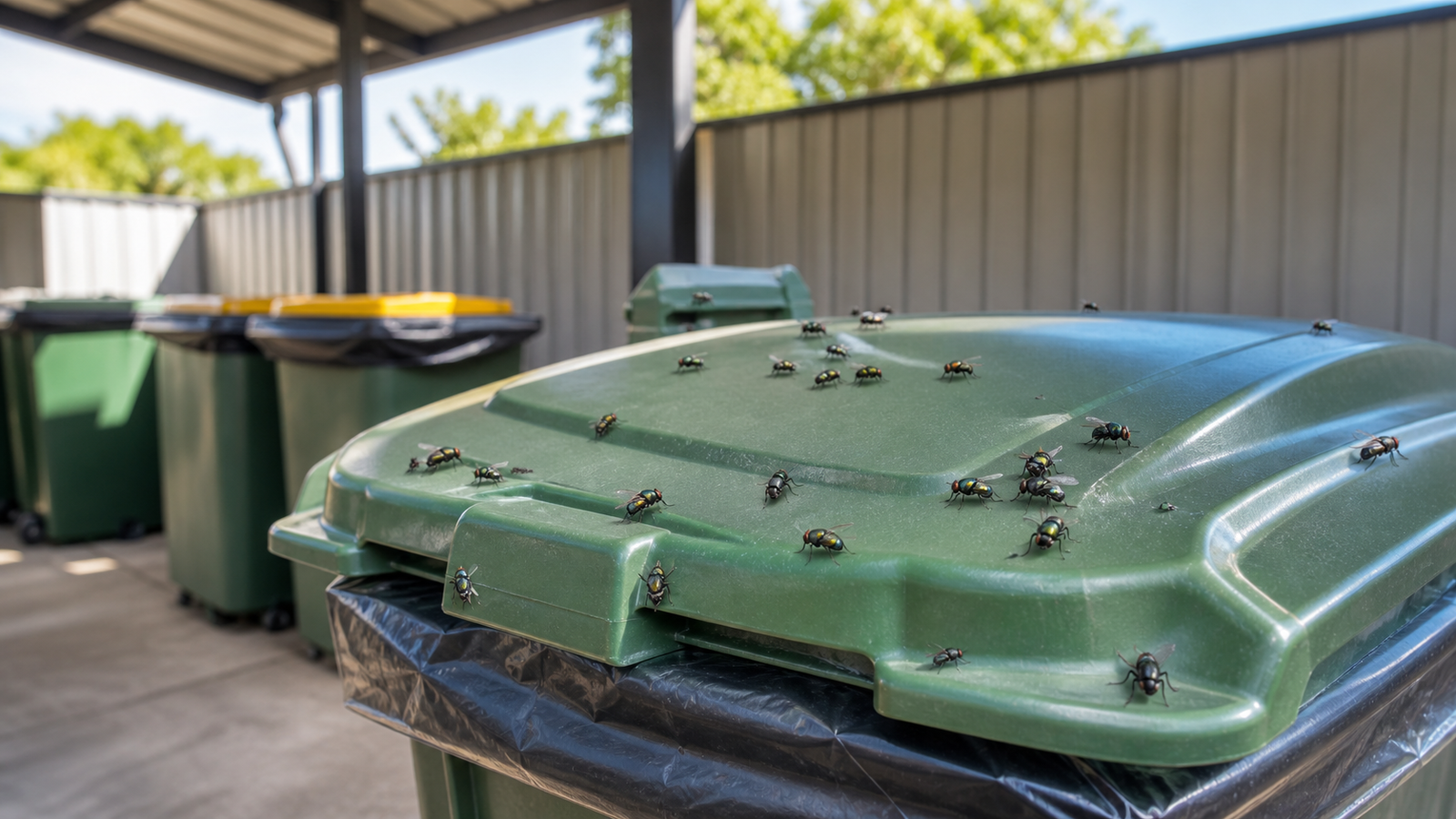
Home/Flies Control Melbourne
Homes & food premises · Melbourne-wide · 24/7Flies Control Melbourne|Same Day Fly Treatment
Flies taking over the kitchen? We treat flies across Melbourne the same day, at the breeding source rather than the window. Call 0435 073 966 for a free quote.
Flies everywhere? Start here
Tell us your postcode and where they are worst. A technician calls you back with a clear written quote.
Request your quote
Takes under a minute – postcode and what you have seen is enough.
Your details go to our Melbourne office only.
Flies are a breeding-source problem, not a spraying problem
A female house fly lays around 500 eggs in her lifetime, and an egg becomes an adult fly in about seven days in Melbourne summer conditions. That maths is the whole story: kill every adult in the room and, if the breeding source is untouched, a fresh generation replaces them inside a week.
So the actual job is finding what they are breeding in. In practice it is nearly always one of a short list: the bin and the bin area, a blocked or greasy drain, pet waste in the yard, fallen fruit, a compost heap – or something dead in a wall or roof.
Drain flies are the clearest example. They breed in the organic film lining the inside of the pipe, which no amount of surface spray or bleach down the sink will touch. The treatment that works is a biological foam that digests the film itself, and once that is gone the flies have nowhere to lay.
If you are in a food business this matters more: a visible fly problem can trigger an immediate council closure. Which is why our commercial fly work starts with drains and waste handling, not with a light trap on the wall.
House Fly, Blowfly Or Drain Fly?
Three flies, three completely different breeding sources – and the source is the job.
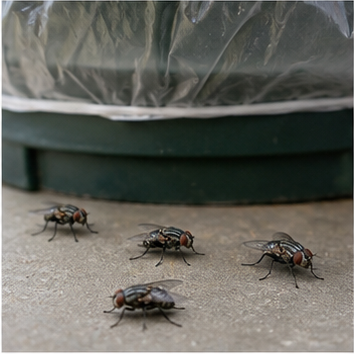
House fly
Musca domestica – 6-7mm
The everyday grey fly with four dark stripes on the thorax. Lands constantly on food and surfaces, and moves between the bin and your bench, which is what makes it a genuine contamination risk.
Where it is breeding: Bins, bin areas, pet waste, compost and food debris. Treatment targets the waste handling and a residual on the surfaces they rest on – fences, eaves, bin enclosures.

Blowfly
Calliphora species
Large, loud, metallic blue or green. A couple indoors in spring is normal. A sudden cluster at one window is not – it usually means something has died in a wall, roof or subfloor.
Where it is breeding: Carcasses, meat waste and pet waste. If we find a cluster at one window, the honest answer is often that this is a dead animal job first and a fly job second.
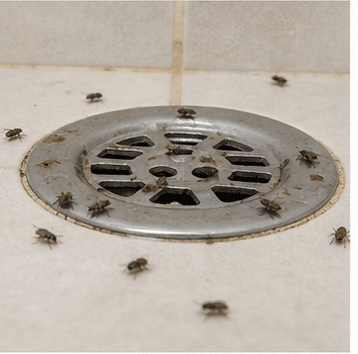
Drain fly
Psychodidae – small, moth-like
Tiny, fuzzy, held like a little moth, sitting on walls near sinks, floor wastes and showers. Weak fliers that hop rather than fly, and they never seem to leave the same square metre.
Where it is breeding: The organic film inside the drainpipe. Surface spray and bleach do nothing – it needs a biological foam that digests the film the larvae live in.
What The Flies Are Telling You
Six observations and what each one points at.
A sudden cluster at one window, one room
Classic sign that something has died in that wall, roof void or subfloor. Treat this as a dead animal call rather than a fly call.
Small moth-like flies on the wall near a sink
Drain flies. The breeding site is inside the pipe, which is why cleaning the surface never resolves it.
Tiny flies hovering over fruit or the recycling
Fruit flies. Almost always fallen fruit, an open bottle, or residue in the recycling bin rather than anything structural.
Flies worst near the bin enclosure
The most common domestic source in Melbourne. Bin hygiene and a residual on the enclosure surfaces does more than any indoor spraying.
Flies in a commercial kitchen despite regular cleaning
Usually floor wastes, grease traps and the gap under equipment. These are the areas surface cleaning routinely misses and auditors reliably check.
Numbers spike after warm, wet weather
Egg to adult takes about a week in summer heat. A warm wet spell accelerates every breeding site on the property at once.
Four Steps, One Clear Quote
Find the source, treat the source, then deal with the adults.
Find the breeding source
Bins, drains, floor wastes, pet waste, compost, fallen fruit – and roof and wall cavities if the pattern suggests a carcass. Without this step, treatment is temporary by design.
Clear written quote
Findings and price before we start. If the real answer is a dead animal in the wall or a blocked grease trap, we will tell you that rather than sell you a fly spray.
Treat the source
Biological foam for drains that digests the organic film, targeted treatment of waste areas, and advice on the handling changes that keep it gone.
Treat resting surfaces
A residual on the surfaces flies actually rest on – eaves, fences, bin enclosures and wall surfaces – plus light traps in commercial settings where sprays are inappropriate.
Fly Control Cost Melbourne
Published, quoted in writing, and quoted on the source rather than the symptom.
Fly treatment
Residential. Source identification, waste-area treatment and external residual.
Drain fly treatment
Biological foam through the affected drains and floor wastes.
Commercial kitchen
Drains, grease traps and waste areas, with records for your food safety file.
Fly program, commercial
Scheduled visits with light trap servicing and documentation, per visit.
What the price covers: finding and treating the breeding source, a residual on resting surfaces, and written prevention advice specific to your bins, drains and waste handling.
Comparing quotes? Melbourne fly treatments start around $169-199. The question to ask is whether they will find the breeding source or just spray and set traps – the second one comes back within a week. Send us any written quote and we will beat it by 5%.
The source, not just the swarm
A fly treatment that ignores the breeding site is a one-week result. Everything we quote is built around finding and removing the source.
Three Things Most Fly Companies Will Not Tell You
Killing adults changes nothing
Egg to adult is about a week in Melbourne summer, and one female lays around 500 eggs. Spray the room, leave the source, and you are back where you started in seven days.
Bleach does nothing for drain flies
They breed in the organic film lining the pipe. Bleach runs straight past it. It needs a biological foam that digests the film, which is why DIY never resolves this one.
A cluster at one window is usually a carcass
If blowflies appear suddenly in one room, the fly treatment is not the job – finding what died in the cavity is. We would rather tell you that on the phone.
Often Booked With Fly Control
Same crew, same visit where it makes sense.
Fly Treatment Across Every Melbourne Suburb
One number covers the whole metro area, with no travel surcharge.
Flies Control Melbourne FAQs
The questions we are asked most, answered straight.
How much does fly control cost in Melbourne?
Ours starts from $169 for a residential treatment, $199 for drain fly treatment with biological foam, and $299 for a commercial kitchen including drains and grease traps. Melbourne rates generally start around $169-199.
Why do the flies keep coming back after I spray?
Because the breeding source is untouched. A female house fly lays around 500 eggs and egg-to-adult takes about a week in Melbourne summer, so a fresh generation replaces the ones you killed within days. The source is the job.
How do I get rid of drain flies?
Not with bleach or surface spray – they breed in the organic film lining the inside of the pipe, and bleach runs straight past it. It needs a biological foam that digests the film itself. Once that is gone the flies have nowhere to lay.
Why are there suddenly lots of big flies in one room?
That is the classic sign of a dead animal in the wall, roof void or subfloor. Blowflies gather at the nearest window to the carcass. In that case the fly treatment is secondary – finding and removing the carcass is the actual job.
What are the tiny flies around my fruit bowl?
Fruit flies, breeding in fallen or overripe fruit, open bottles, or residue in the recycling. It is almost always a housekeeping source rather than a structural one, and we will tell you if that is all it is.
Can flies make you sick?
House flies move between waste and food surfaces and carry bacteria on their bodies and feet, so yes, they are a genuine contamination route. It is the reason food premises are held to a strict standard on them rather than a matter of nuisance.
Do you do fly control for restaurants and cafes?
Yes, and it starts with drains, grease traps and waste handling rather than a light trap on the wall. You get service records for your HACCP file, and we schedule outside trading hours.
How long does fly treatment take to work?
Adults drop within hours of treating resting surfaces. The lasting result depends on the source: once a drain or waste source is treated, numbers fall away over a week or so as no new generation emerges.
How can I prevent flies coming back?
Seal the bins and clean the bin area, keep drains and floor wastes clear, pick up pet waste and fallen fruit, and fit fly screens. Those five things resolve most domestic fly problems more reliably than any spray.
Do you service my suburb?
Yes – all of metro Melbourne, from the CBD out through the northern, eastern, southern, bayside and western suburbs, with no travel surcharge.
Book fly control before 2pm today
Send your postcode and where they are worst. We will call back with a clear written quote.
Get my free quote
No obligation. Answered 24/7.
Your details go to our Melbourne office only.
Get your free quote
Quoted in writing before we start. Answered 24/7.