
Rodents & Wildlife
Termites & Timber
Stinging Pests
Crawling Insects
Property Programs
Not sure what you have?Describe what you have seen and we will identify it – no charge, no obligation.
All Services
Rodents & Wildlife
Termites & Timber
Stinging Pests
Crawling Insects
Property Programs
Company
Our WorkPricingProcessAboutContactCall 0435 073 966
Home/Rodent Control Melbourne
Rats & mice · Melbourne-wide · 24/7Rodent Control Melbourne|Rat And Mice Control
Scratching in the roof or walls? We treat rats and mice across Melbourne the same day. Baiting, trapping and proofing included. Call 0435 073 966 for a free quote.
Rats or mice in the house? Start here
Tell us your postcode and what you are hearing. A licensed technician calls you back with a clear written quote.
Request your quote
Takes under a minute – postcode and what you have seen is enough.
Your details go to our Melbourne office only.
Baiting without proofing is a subscription, not a solution
A rodent problem is not really an animal problem, it is a hole problem. A mouse gets through a gap the width of a pencil, a rat through one the width of your thumb. Kill everything inside and leave those gaps open, and the next rodent moves in within weeks – which is exactly why some operators quote the baiting cheap and never mention the sealing.
There is a second cost nobody advertises. A rodent that eats bait usually dies where it nests – in a wall cavity or under insulation, somewhere you cannot reach. Seven to ten days later the smell starts, and the removal plus deodorising costs more than the proofing would have.
And bait does not stop at the rat. Secondary poisoning is real: cats, dogs and Melbourne’s urban owls and tawny frogmouths eat poisoned rodents and take the dose with them. We use tamper-resistant stations, place them where pets and wildlife cannot reach, and lean on trapping and proofing wherever the situation allows.
So every rodent quote we write includes the entry points. That is the part that actually ends it.
Rat or Mouse? It Changes the Treatment
Get the species wrong and the bait, the station placement and the proofing gaps are all wrong.
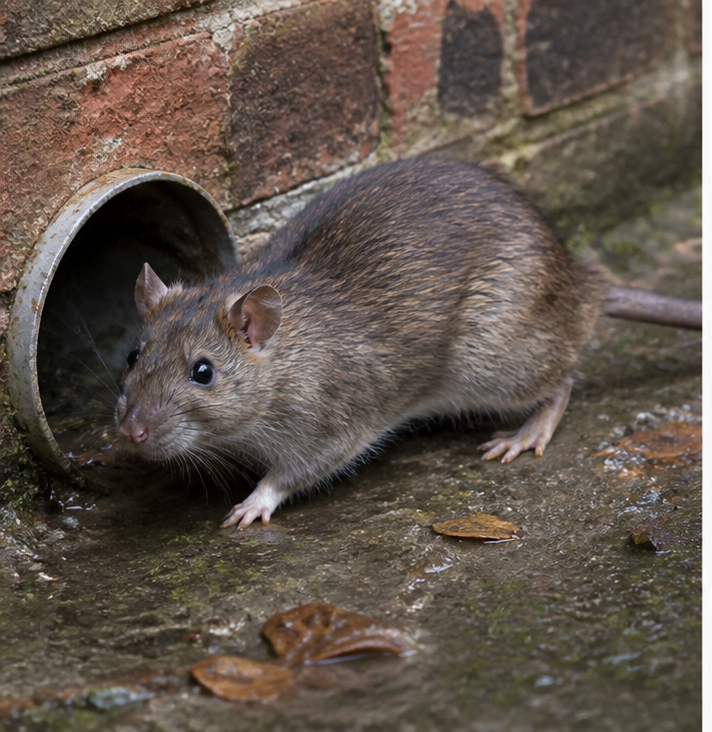
Norway rat
Rattus norvegicus – the burrowing rat
Big and heavy at 200-500g, blunt nose, small ears, tail shorter than the body. Lives low – subfloors, drains, compost, burrows along fence lines.
How we treat it: Ground-level stations and trapping, plus sealing weep holes, air vents and the gap under the door. Droppings are 18-20mm with blunt ends.
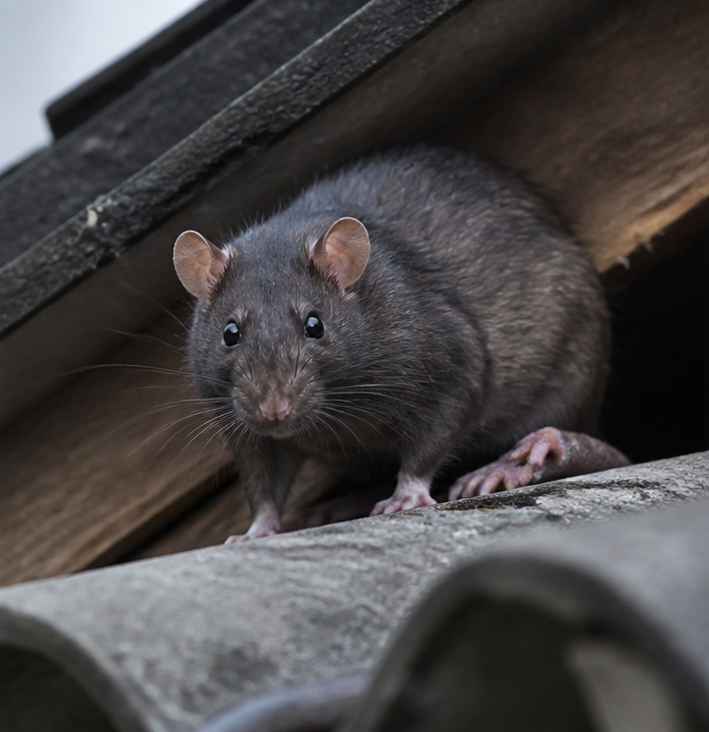
Roof rat
Rattus rattus – the climber
Slimmer, pointed nose, large ears, tail longer than the body. This is the one running along your ceiling at 2am, and it gets in via overhanging branches and roof gaps.
How we treat it: Roof-void stations, trimming branch access, and capping tile gaps and eaves. Droppings are 12-13mm and pointed.
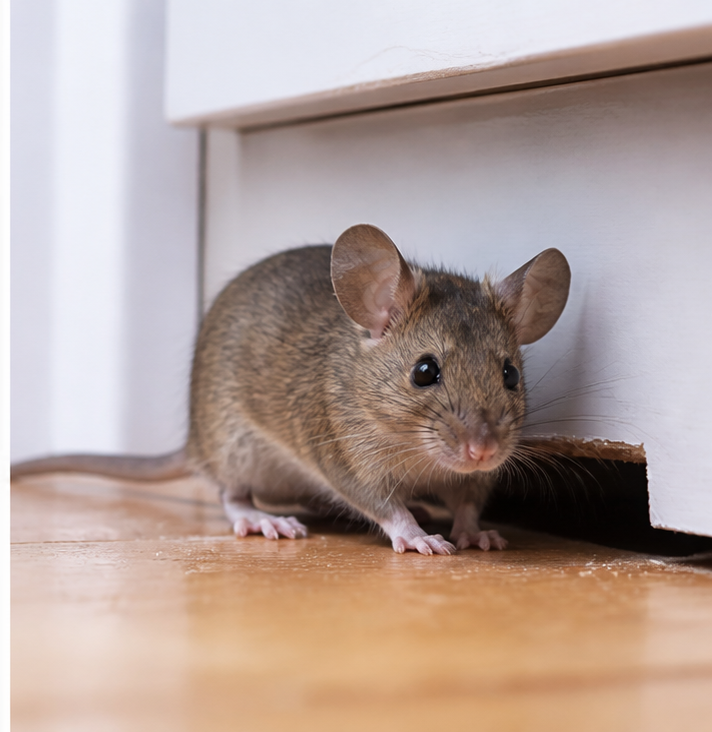
House mouse
Mus musculus
Small, 15-20g, curious and constantly breeding – a female can produce a litter every three weeks. You often see droppings long before you see the mouse.
How we treat it: Many small bait points rather than a few large ones, because mice nibble at dozens of spots. Droppings are 3-6mm, like dark rice grains.
Rats In The Roof? What You Are Noticing
Six things people describe on the phone, and what each one actually tells us.
Fast scurrying overhead, on and off all night
Rodents, not possums. A possum makes two heavy trips a night; rats run in quick bursts and change direction constantly.
Droppings behind the fridge or in the pantry
Fresh droppings are dark and soft, old ones are grey and crumble. Fresh means an active population, not a one-off visitor.
Gnaw marks on skirting, cabling or food packets
Rodent incisors never stop growing so they must gnaw. Chewed electrical cable is the reason rodents are a genuine fire risk, not a scare line.
A greasy dark smear along a wall or beam
A rub mark from the same route used nightly. It tells us exactly where to place stations – and where the entry point is.
The dog or cat fixating on one spot in a wall
They hear it before you do. A pet staring at the same cupboard or wall cavity is often the earliest sign of all.
A sudden bad smell about a week after DIY baiting
Something has died in the cavity. This is the classic supermarket-bait outcome and it needs locating and removing.
Four Steps, One Clear Quote
Inspection first, sealing last – and the sealing is what stops you calling anyone again.
Inspect and identify
We confirm rat or mouse from droppings, runs and rub marks, then check the roof void, subfloor and perimeter. Species and entry route decide everything that follows.
Clear written quote
You get the findings and a quote before work starts, including exactly which entry points need sealing and what that costs.
Treat
Tamper-resistant stations placed out of reach of children and pets, plus trapping where poison is not appropriate – food premises, homes with pets, or roof voids where a carcass would be unreachable.
Proof and prevent
Weep holes, vents, pipe penetrations, eaves and door gaps sealed with steel mesh and appropriate materials. This carries a 12-month warranty.
Rodent Control Cost Melbourne
Published, and quoted in writing after inspection.
Rodent treatment
Inspection, baiting or trapping through the roof void, subfloor and perimeter.
Treatment & proofing
The same treatment plus sealing the entry points, with a 12-month warranty on the seal.
Two-storey or large home
Where the roofline, subfloor and perimeter need more stations and more access.
Dead rodent removal
Carcass located and removed from the cavity, area treated and deodorised.
What the price covers: the inspection, the stations or traps, placement out of reach of children and pets, written findings, and a proofing quote listing every entry point we found.
Comparing quotes? Melbourne rates run from about $180 to $330 for treatment alone, and up to $1,200 for a heavy infestation. A quote with no proofing line on it is not a finished job – ask what happens when the next rat arrives. Send us any written quote and we will beat it by 5%.
12 months on every entry point we seal
The guarantee is on the invoice, not in the sales pitch. If rodents get back in through something we sealed inside the warranty period, we come back at no charge.
Three Things Most Rodent Companies Will Not Tell You
Bait alone is a repeat booking
An empty roof with an open gap is prime real estate. Remove the rodents and leave the hole and you will be calling someone again next autumn. Every quote we write prices the seal.
The bait is what causes the smell
A poisoned rodent dies in the wall cavity where it nests. That is a foreseeable outcome of baiting, not bad luck – which is why we trap instead wherever a carcass could not be reached.
Poison travels up the food chain
Cats, dogs, owls and tawny frogmouths eat poisoned rodents and take the dose with them. We place stations to prevent it and use traps where the risk is real.
Often Booked With Rodent Control
Same crew, same visit where it makes sense.
Rat And Mice Control Across Every Melbourne Suburb
One number covers the whole metro area, with no travel surcharge.
Rodent Control Melbourne FAQs
The questions we are asked most, answered straight.
How much does rodent control cost in Melbourne?
Our rodent treatment starts from $179, which covers the inspection and baiting or trapping through the roof void, subfloor and perimeter. Treatment plus proofing – the option that actually ends the problem – starts from $449 with a 12-month warranty on the seal. Melbourne rates generally run $180 to $330 for treatment alone and up to $1,200 for a heavy infestation, so compare what is included before comparing the number.
How do I get rid of rats permanently?
Seal the way in. Rodent control has two halves and only one of them is the treatment. Bait or traps clear the current population; sealing the weep holes, vents, pipe penetrations, eaves and door gaps is what stops the next one moving in. A quote that prices only the first half is quoting you half a job.
Is rat bait safe around my pets and kids?
We use tamper-resistant stations placed where children and pets cannot reach them, and we will tell you where each one is. Where the risk is real – homes with dogs that dig, food premises, or a roof void where a carcass could not be retrieved – we use trapping instead. Tell us about pets when you book and the technician plans around them.
Why is there a bad smell after rodent treatment?
Because a poisoned rodent dies in its nest, usually inside a wall cavity or under insulation. The smell peaks at seven to ten days and flies at one window are the giveaway. It is a predictable consequence of baiting, which is exactly why we trap instead in places where we could not retrieve a carcass. If it does happen, our dead rodent removal is from $149.
How can I tell rats from mice?
Droppings are the quickest test. Mouse droppings are 3-6mm and look like dark rice grains. Rat droppings are 12-20mm – pointed at the ends for a roof rat, blunt for a Norway rat. The sound differs too: mice are light and constant, rats are heavier and you can hear direction changes.
How long does rodent control take to work?
You will usually notice a drop in activity within a few days and it is typically resolved inside two weeks. Mice tend to go faster than rats because they feed at many points. If activity is unchanged after two weeks, something is wrong with the placement and we come back.
Do rats really chew electrical wiring?
Yes. Rodent incisors grow continuously so they gnaw to wear them down, and cable sheathing is a convenient hardness. It is one of the genuine reasons not to leave a roof-void infestation alone – not a scare line invented to sell a treatment.
Do you do commercial rodent control?
Yes. Cafes, restaurants, warehouses and food manufacturers get a documented program – station map, service records and reporting an auditor will accept. In food premises we lean on trapping and proofing rather than poison, because a carcass in the wrong place is a bigger compliance problem than the rodent was.
Do you service my suburb?
Yes – all of metro Melbourne, from the CBD out through the northern, eastern, southern, bayside and western suburbs, with no travel surcharge.
When are rodents worst in Melbourne?
Autumn, as the temperature drops and rodents move indoors looking for warmth, and again in spring as populations rebuild. Late March through winter is our busiest rodent period, so book proofing before autumn if you have had them before.
Book rodent control before 2pm today
Send your postcode and what you are hearing. We will call back with a clear written quote and, where a slot is open, be there today.
Get my free quote
No obligation. Answered 24/7.
Your details go to our Melbourne office only.
Get your free quote
Quoted in writing before we start. Answered 24/7.